User Registration & Identity Lifecycle
This document describes how Hawiyati creates, verifies, and manages user accounts across three deployment scenarios: greenfield consumer registration, enterprise provisioning, and SP-initiated access. It defines the assurance level model, account state transitions, the limited-session completion token design, and the governed bulk import pipeline. All implementation decisions trace to the September 2026 architecture review.
This document describes how Hawiyati creates, verifies, and manages user accounts across three deployment scenarios: greenfield consumer registration, enterprise provisioning, and SP-initiated access. It defines the assurance level model, account state transitions, the limited-session completion token design, and the governed bulk import pipeline. All implementation decisions trace to the September 2026 architecture review.
The sections below cover user registration, KYC, and identity lifecycle implementation. For a full module map with ports, gRPC boundaries, and deployment topology, see the Implementation Guide.
Overview & Scope
This document describes how Hawiyati creates, verifies, and manages user accounts across three deployment scenarios: greenfield consumer registration, enterprise provisioning, and SP-initiated access. It defines the assurance level model, account state transitions, the limited-session completion token design, and the governed bulk import pipeline. All implementation decisions trace to the September 2026 architecture review.
The governing constraint throughout this document: lab/ocr-mrz-test fixes must not be synced to hawiyati-kyc until the team explicitly confirms. Until that promotion happens, KYC-04 (supported documents reference) must describe only verified production behavior.
Assurance level is sourced exclusively from kyc_profiles.current_level — a column that already exists in the database. No users.assurance_level column is added. Adding such a column would create two competing sources of truth and has historically caused consistency bugs in identity systems.
Three deployment scenarios
| Scenario | Primary user | Entry path | KYC required |
|---|---|---|---|
| Greenfield consumer | End user | Self-service /idp/register |
Policy-driven; default L1 for most SPs |
| Enterprise / workforce | Employee or contractor | SCIM provision, LDAP JIT, invitation, or CSV import | Source-assurance carry-over or grace period |
| SP-initiated | End user arriving from a service | SAML AuthnRequest or OIDC authorization → registration | SP minimum assurance triggers KYC gating after login |
Assurance Levels L0–L4
Hawiyati defines five assurance levels aligned with NIST SP 800-63A-4. Levels describe identity proofing assurance (IAL) for a registered identity. The Java type is IdentityAssuranceLevel — an enum with satisfies(), fromString(), and capAtFreezeLevel() methods. Unknown values fail closed to L0.
| Level | Name | Evidence required | Status |
|---|---|---|---|
| L0 | Unverified | Email or phone confirmation only — no identity document. Default on registration. | Active |
| L1 | Self-asserted | Name, date of birth, address provided and consistent; no documentary evidence required. | Active |
| L2 | Document-verified | Government-issued identity document: Algerian CIN, passport, or driving licence. OCR-extracted fields pass consistency checks. Document fingerprint stored. | Active |
| L3 | Biometric-verified | Document verification plus liveness detection and face match against the chip or reference photo. | Frozen — not yet in production |
| L4 | In-person supervised | All L3 evidence collected by a trained officer in a controlled environment with chain-of-custody records. | Frozen — not yet in production |
KycDecisionService.approve() refuses to set kyc_profiles.current_level above L2 until a production-grade biometric integration is approved. The cap is enforced by IdentityAssuranceLevel.capAtFreezeLevel(). Any session requesting L3 or L4 achieves at most L2 and is routed to manual review.
Java enum definition
Authorization contract
Minimum assurance for a request is read from the AuthenticationPolicy associated with the current SP entity ID and action (login, resource, API scope). It is never derived from a username lookup alone. Effective assurance for an authorization decision combines:
kyc_profiles.current_level via KycGateService.effectiveLevelFor(username)AuthenticationPolicy for the current SP and actionAccount Status Model
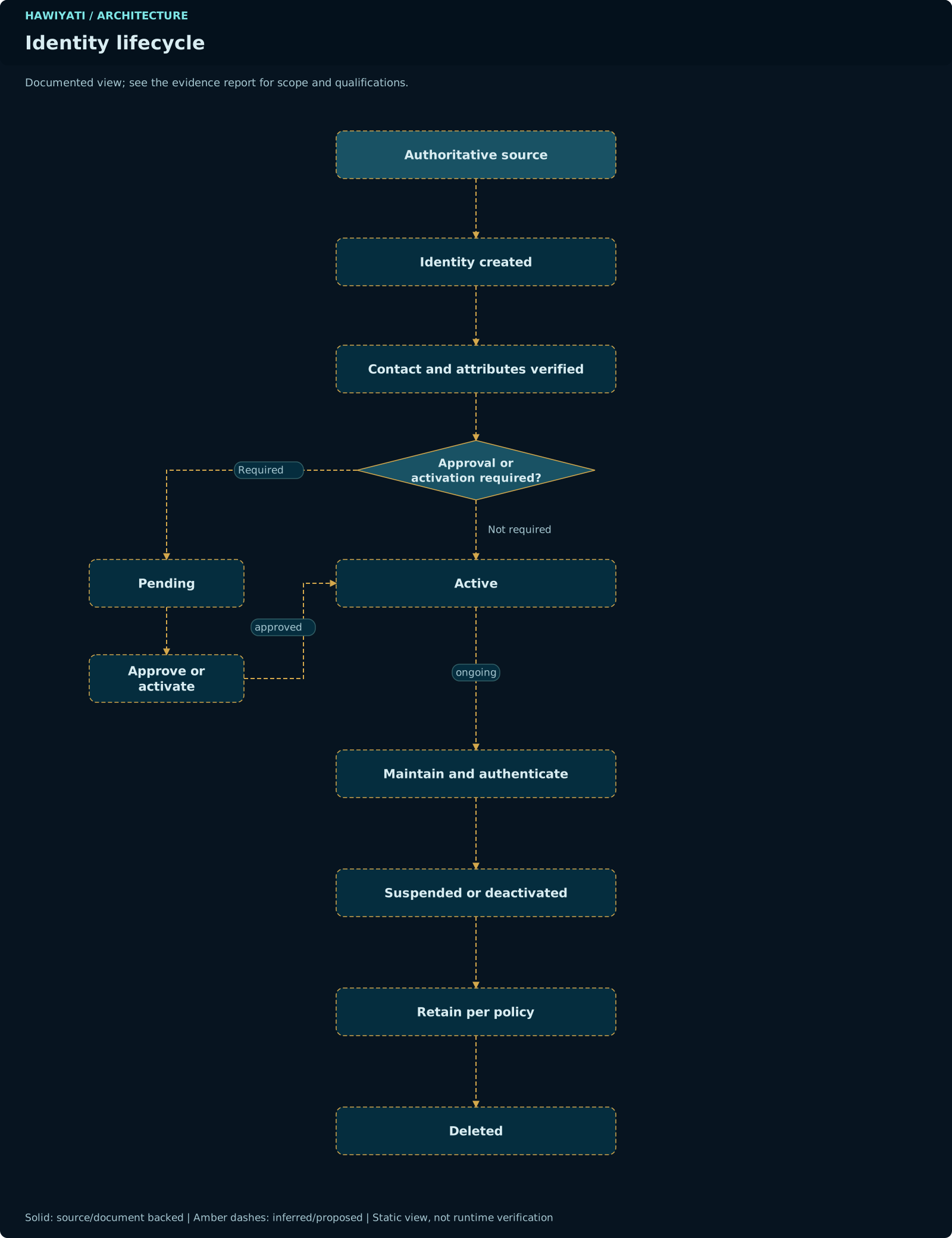
User status is represented by two independent boolean flags on the users table. No status enum column is added. Presentation states like ACTIVE_LIMITED are computed at request time from kyc_profiles.current_level plus the SP/action policy minimum. Adding a third column would require a migration and introduce a third source of truth.
| active | pendingApproval | Presentation state | Allowed operations |
|---|---|---|---|
true | false |
ACTIVE | Full access; no KYC gate if assurance ≥ SP minimum |
true | false |
ACTIVE_LIMITED (computed) | Login succeeds; SAML/OIDC issuance gated behind KYC completion token flow; account portal, KYC, consent, logout accessible |
false | true |
MIGRATED_UNCLAIMED | Account exists but cannot authenticate; activation requires identity claim flow |
false | false |
SUSPENDED | No operations; admin unlock required |
false | true |
PENDING_APPROVAL | Self-registered but awaiting admin activation; blocked from login |
ACTIVE_LIMITED is never written to the database. It is the runtime result of: user is active AND effectiveLevelFor(user) does not satisfy policyMinimumFor(spEntityId). This keeps the database normalized and prevents stale states.
Account state transitions
active=true, pendingApproval=false on creation (no approval gate configured) or active=false, pendingApproval=true if registration policy requires admin approval.active=false, pendingApproval=true (MIGRATED_UNCLAIMED). Never immediately active.active=true, pendingApproval=false.active=false, pendingApproval=false. Existing sessions are revoked. Restoration requires explicit admin unsuspend.Source of Truth Decisions
Every identity record must carry source_instance_id (origin system) and external_id (immutable source key). These are added in V58 migration. The combination (source_instance_id, external_id) is unique-indexed, preventing duplicate accounts from the same source.
| Data | Authoritative store | Never |
|---|---|---|
| Assurance level | kyc_profiles.current_level | Not users.assurance_level |
| Source identity key | users.external_id + users.source_instance_id | Not a nullable scim_external_id column |
| Completion session | identity_completion_session DB table (HMAC-SHA256 token hash) | Not a boolean kycRequired WebSession attribute |
| SP business intent | onboarding_continuation.sp_entity_id | Not a raw sp_initiation_url (open-redirect risk) |
| Claim token | account_claim_token.token_hash (HMAC-SHA256) | Not raw token in DB |
| Document deduplication | document_fingerprint.fingerprint (HMAC-SHA256 of normalized fields) | Not file SHA-256 (cropping defeats it) |
Self-Service Registration Flow
Direct registration at /idp/register creates a Hawiyati-native account. The server collects a username, password, email, and consent. Username availability is not checked before submission — the unique constraint raises a DataIntegrityViolationException which the server maps to the generic error unique_attribute_taken without revealing which field is taken.
The current RegistrationController.java:311 performs a pre-check if (userService.existsByUsername(username)) before the database insert. This discloses whether a username is registered, enabling account enumeration. The fix is to remove the pre-check entirely and rely only on the constraint exception.
active=true, pendingApproval=false (or pending if approval required). Consent record captures version, IP, user-agent.active=false until confirmed.onboarding_continuation record storing only sp_entity_id. Redirect user to KYC or account setup. Initiation URL is resolved from SP registry at redemption — never stored.Consent record
The ConsentRecord entity already captures ip_address and user_agent (ACT-P0-06 confirmed complete). A regression test is required to prevent this from being stripped in future refactors.
Invitation & Admin-Driven Registration
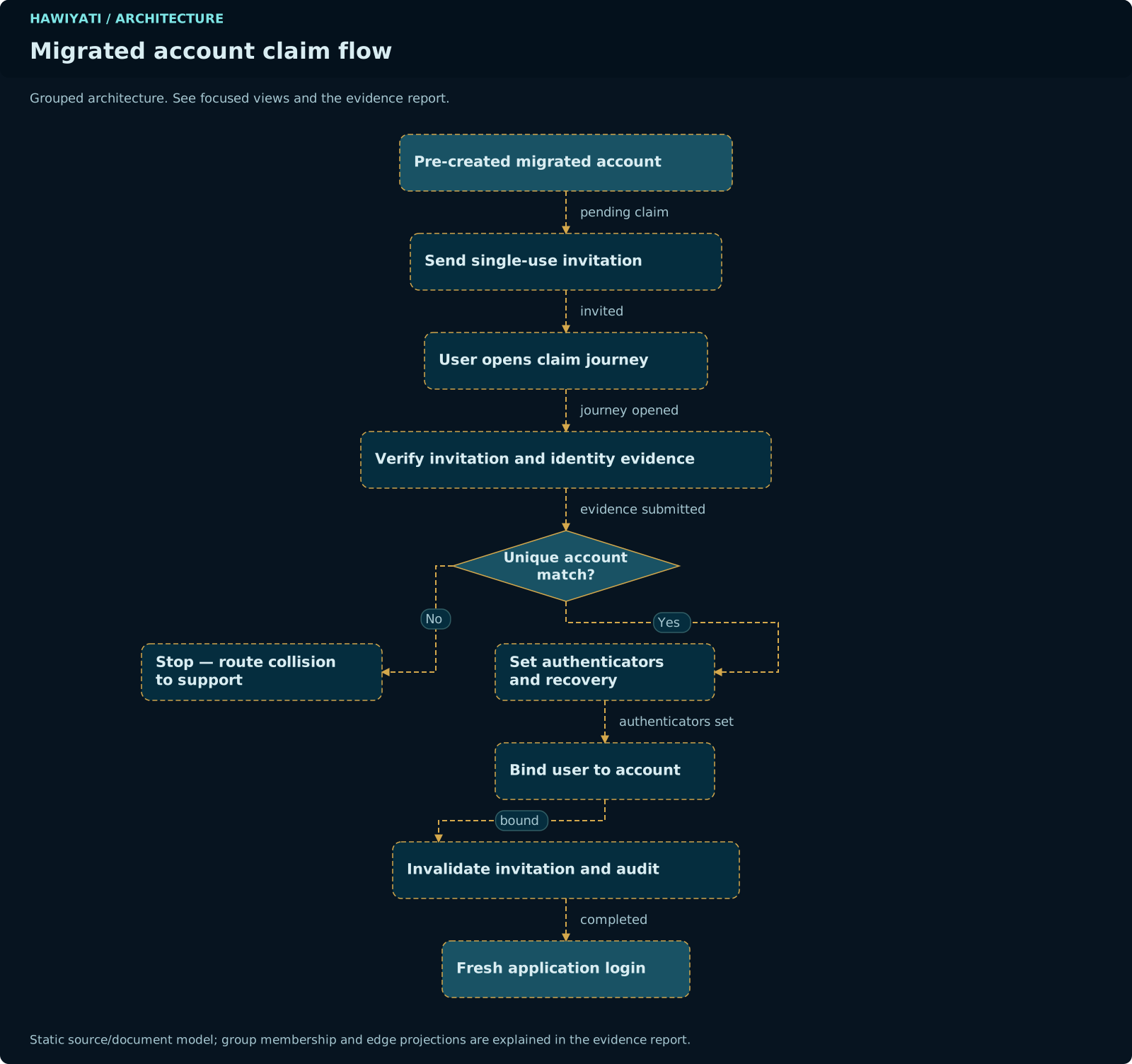
When registration is closed or policy-restricted, administrators create accounts and invite users to claim them. The invite sends an account claim token. The token is 256-bit random, stored as HMAC-SHA256, and is single-use. There is no plaintext token in the database.
active=false, pendingApproval=true. Email or external ID set; no password yet.AccountClaimTokenService.generate(userId, "CLAIM_LINK", 72) — 256-bit random, 72-hour TTL, stored as SHA-256 hash with purpose and userId bindingNotificationOutboxService.enqueueIfAbsent() with template key claim-link-v1 and userId. Raw token is NOT in the payload./account/claim?token=<raw> — token verified and atomically consumed in one conditional UPDATEactive=true, pendingApproval=false. User sets their password and proceeds to KYC if required.SP-Initiated Registration
When a user arrives at Hawiyati from an SP (SAML AuthnRequest or OIDC authorization request) and has no account, the IdP must either create an account or guide the user through self-service registration while preserving the SP's business intent for up to 7 days. Live protocol state (AuthnRequest, PKCE verifier, nonce) lives in Redis/WebSession for 10–15 minutes only and is never replayed after it expires.
Storing a raw sp_initiation_url from the caller and following it after registration is an open-redirect vulnerability. The fix: store only the registered sp_entity_id as a foreign key to the SP registry. The initiation URL is resolved from the registry at consumption time — an SP not in the registry cannot redirect the user anywhere.
Intent persistence design
| What is stored | Where | TTL | Purpose |
|---|---|---|---|
| Live SAML/OIDC protocol state (AuthnRequest, state, nonce, PKCE) | WebSession / Redis | 10–15 min | Protocol-level; expired state is discarded, never replayed |
| SP business intent (which SP the user came from) | onboarding_continuation DB table | 7 days | Survives KYC flow; consumed by fresh SP-initiation on completion |
On activation the continuation is consumed atomically (UPDATE … WHERE consumed=FALSE checking affectedRows == 1) and the user is redirected to spRegistryService.getInitiationUrl(spEntityId) — a fresh SP flow, not a replay of the stale protocol object.
Enterprise Provisioning
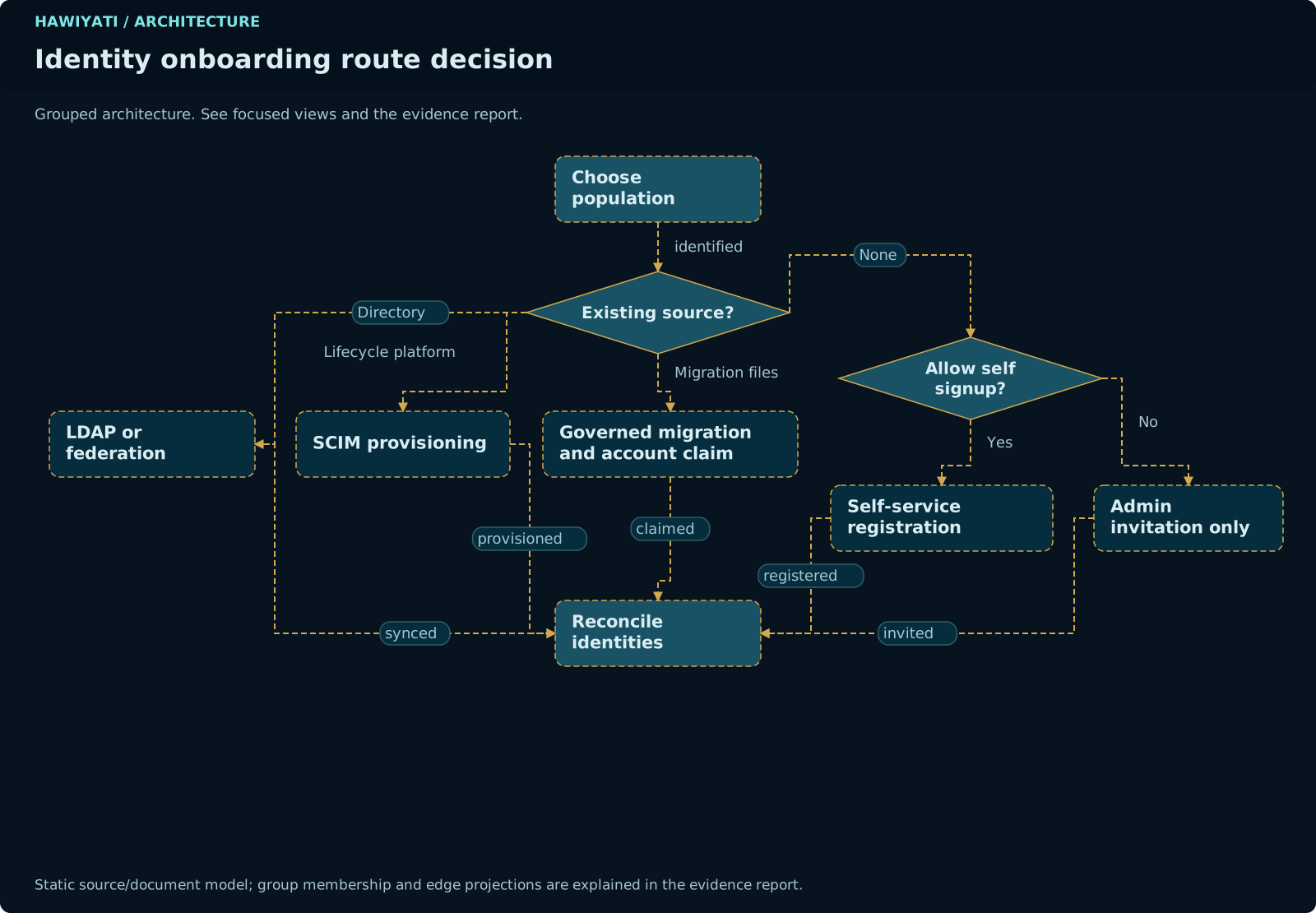
Enterprise accounts can enter Hawiyati via three channels, all producing MIGRATED_UNCLAIMED accounts:
| Channel | Trigger | Identity binding | Next step |
|---|---|---|---|
| SCIM 2.0 | POST /scim/v2/Users from directory | external_id + source_instance_id from HawiyatiExtension |
Account claim token or LDAP JIT on first login |
| LDAP JIT | Successful LDAP bind at login | DN or samAccountName mapped to external_id |
Immediate activation; KYC grace period applies |
| CSV bulk import | Admin uploads file, approves, commits | external_id from CSV column |
Invitation email with claim token sent to all rows |
The Hawiyati SCIM extension (urn:hawiyati:params:scim:schemas:extension:2.0:User) carries only: externalId, sourceInstanceId, pendingApproval. Password hashes, assurance levels, and migration tier fields are explicitly forbidden from SCIM channels. Receiving any of these fields must not silently map them — the field mapping must not exist.
KYC State Machine
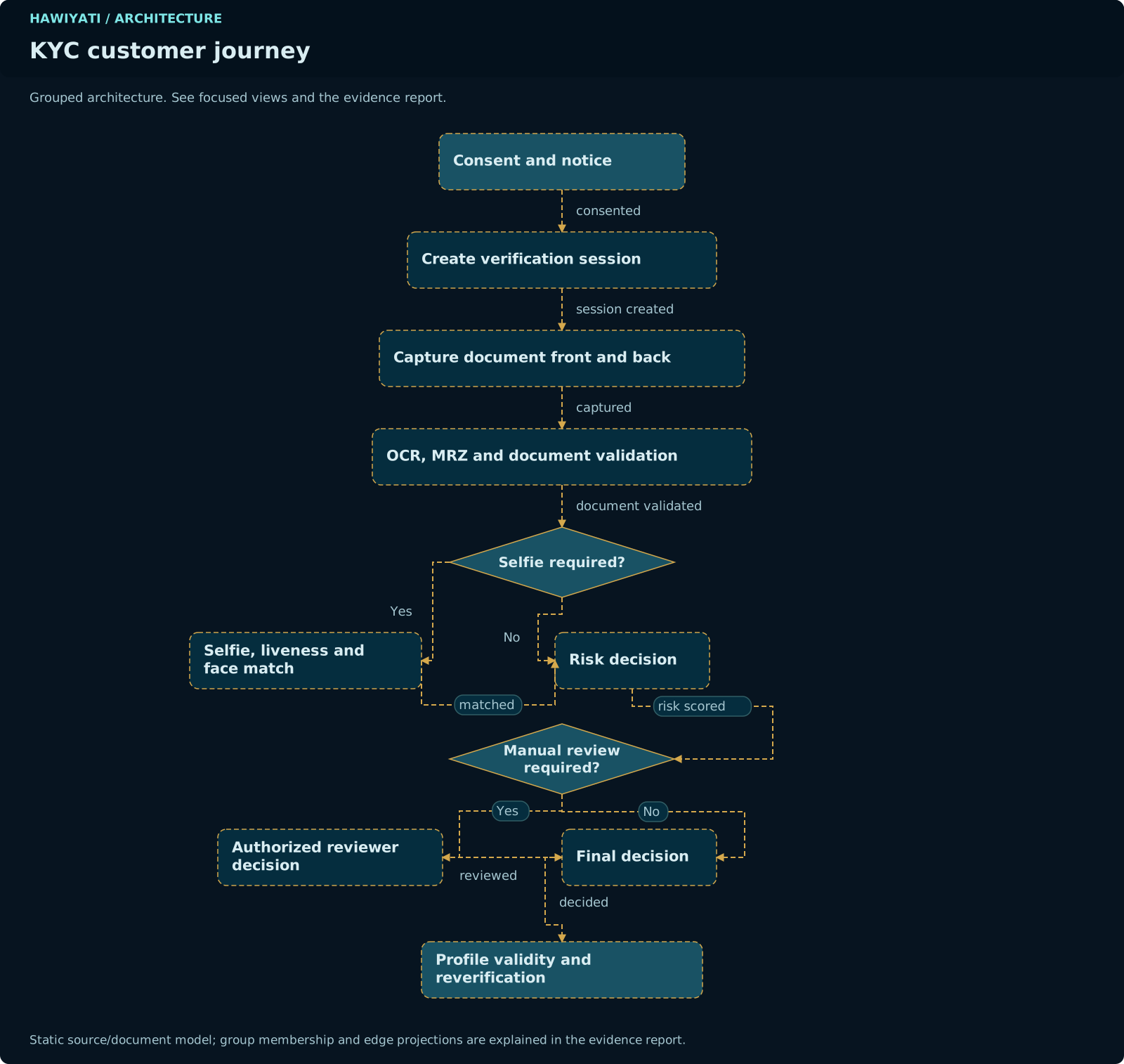
KYC verification is modeled as a state machine on KycVerificationSession. Each session is scoped to one user and one attempt. The state machine prevents illegal transitions: a session cannot jump from PENDING to APPROVED without passing through evidence capture and review states.
| State | Meaning | Allowed transitions |
|---|---|---|
| PENDING | Session created; awaiting document upload | → DOCUMENT_UPLOADED |
| DOCUMENT_UPLOADED | File received; OCR processing queued | → PROCESSING |
| PROCESSING | OCR/MRZ extraction in progress | → DOCUMENT_VALIDATED, → PROCESSING_FAILED |
| DOCUMENT_VALIDATED | Fields extracted; decision engine evaluating | → MANUAL_REVIEW_REQUIRED, → APPROVED (automated only) |
| MANUAL_REVIEW_REQUIRED | Low confidence score or duplicate-document risk flag; awaiting human reviewer | → APPROVED, → REJECTED |
| APPROVED | Terminal — identity proofed; kyc_profiles.current_level updated | — (terminal) |
| REJECTED | Terminal — insufficient evidence; user may start a new session | — (terminal, new session allowed) |
| PROCESSING_FAILED | OCR system error; user may retry | → PENDING (retry) |
Approval logic
When a reviewer or automated decision approves a session:
IdentityAssuranceLevel.capAtFreezeLevel(requested) — L3/L4 requests become L2kyc_profiles.current_level — never to users table. Only upgrade, never downgrade via this path.KYC_APPROVED with achieved level, reviewer ID, and session IDSupported document types (production)
| Document | Country | Capture sides | MRZ | Max file size |
|---|---|---|---|---|
| Algerian National ID (CIN) | DZA | Front + Back (both required) | TD1 (3-line) | 10 MB per side |
| Algerian Passport | DZA | Photo/data page only | TD3 (2-line) | 10 MB |
| Foreign Passport | Any | Photo/data page only | TD3 (2-line) | 10 MB |
| Driving Licence | DZA | Front + Back (both required) | None | 10 MB per side |
Advanced OCR/MRZ pipeline (lab/ocr-mrz-test) is not yet promoted to hawiyati-kyc. Do not document these features as production-supported until the promotion is explicitly confirmed.
Evidence & Document Fingerprinting
When a document is captured, Hawiyati computes an HMAC-SHA256 fingerprint of the normalized document identity — country, document type, and document number. This fingerprint is stored in document_fingerprint (schema: hawiyati_identity). A duplicate match is a risk signal that routes the session to manual review. It is not a hard rejection, because legitimate scenarios exist (document reuse after name change, duplicate legitimate applications).
Normalization algorithm
A SHA-256 hash of the uploaded image file is defeated by any crop, rotation, re-encoding, or quality change. The HMAC fingerprint hashes only the semantically meaningful fields (country, document type, document number), which are stable across capture variations. The raw document number is never stored in the fingerprint table.
Duplicate detection behavior
| Scenario | Action |
|---|---|
| Fingerprint matches a different user | Set session.duplicateDocumentRisk=true, transition to MANUAL_REVIEW_REQUIRED. Log warning with session ID and existing user ID. Do not hard-reject. |
| Fingerprint matches the same user | Allow — same user retrying or updating their submission. Save the new fingerprint record; deduplicate by userId. |
| No existing fingerprint found | Save new document_fingerprint record. Continue automated validation. |
Key management
The HMAC key is injected from application config (hawiyati.kyc.document-fingerprint-key, base64-encoded 256-bit key). The key_version column in document_fingerprint enables key rotation — old fingerprints can be re-keyed on rotation by re-normalizing and re-hashing each row.
Limited Completion Session (KYC Gate)
When a user authenticates successfully but their kyc_profiles.current_level does not satisfy the SP's minimum assurance, Hawiyati issues a first-party completion token instead of throwing an exception or storing a boolean flag on the WebSession. The token is stored server-side as HMAC-SHA256, has a 15-minute TTL, and is single-use.
The current LoginController.java:876–901 throws KycRequiredException which propagates through the reactive chain and causes a response deadlock. It uses a boolean kycRequired session attribute which cannot be validated, expires with the session, and grants no route restrictions. Both issues are fixed by this design.
Token design
| Property | Value |
|---|---|
| Entropy | 256-bit (32 bytes, SecureRandom), URL-safe base64 ≥43 characters |
| Stored form | SHA-256 hash only — raw token never persisted |
| TTL | 15 minutes (expiresAt = NOW() + 900s) |
| Cardinality | Single-use; consumed atomically on validation |
| Bindings | userId, spEntityId, purpose = KYC_COMPLETION |
| Table | hawiyati_identity.identity_completion_session (V54) |
Route allowlist — what a completion token grants
A user holding only a completion token (no full session assertion) may access the following routes only. Any request outside this list receives a 403.
/account/statusALLOWED/account/kyc/**ALLOWED/account/consent/**ALLOWED/logoutALLOWED/supportALLOWED/saml/idp/ssoDENIED — no assertion issuance/oidc/tokenDENIED — no token issuance/api/**DENIED — no general API access
SP Transaction Continuation
When a user arrives from an SP and must register or complete KYC before the SP assertion can be issued, the IdP must remember which SP they came from for up to 7 days. This is the onboarding_continuation table introduced in V55.
Token design
| Property | Value |
|---|---|
| Stored data | sp_entity_id (FK to SP registry) only. No raw URL stored. |
| Token format | 256-bit random; SHA-256 stored in DB; browser holds raw token in query parameter |
| TTL | 7 days (configurable) |
| Redemption | Atomic UPDATE … SET consumed=TRUE WHERE consumed=FALSE AND userId=?; checks affectedRows == 1 |
| User binding | user_id column; wrong-user attempt returns empty |
| URL resolution | spRegistryService.getInitiationUrl(spEntityId) at consumption time |
Because only a registered SP entity ID is stored (not the caller-supplied URL), an attacker who obtains a continuation token cannot redirect the user to an arbitrary domain. The initiation URL is always resolved from the verified SP registry entry.
Account Claim Tokens
Account claim tokens are purpose-bound, user-bound, single-use tokens used for invitation flows, password-reset links, and migration activation. They live in account_claim_token (V57).
Security properties
| Threat | Mitigation |
|---|---|
| Token replay | Single-use atomic conditional update; atomicRedeem(hash, userId, purpose) returns 0 rows if already consumed |
| Brute force | 256-bit token space = 2256 — computationally infeasible; redemption endpoint rate-limited |
| Wrong channel | purpose column binding — a password-reset token cannot be used for account claim and vice versa |
| Cross-user claim | userId binding — token redeemable only for the user it was created for |
| Concurrent double-redemption | Conditional UPDATE checks consumed=FALSE; exactly one concurrent thread wins |
SCIM Provisioning Model
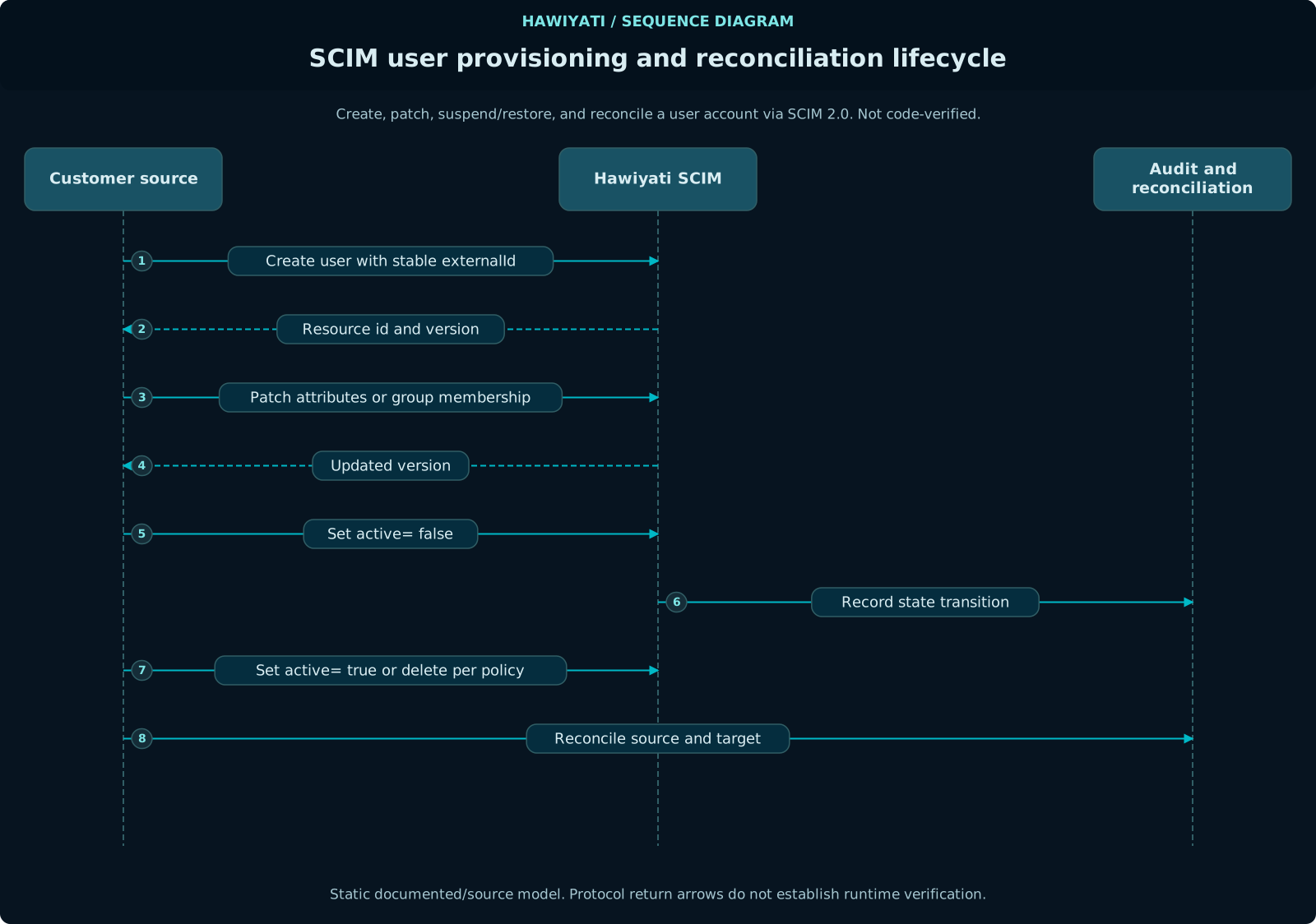
Hawiyati implements SCIM 2.0 inbound provisioning at hawiyati-scim (port 8098). The custom Hawiyati extension carries only the fields needed for identity correlation — not credential migration or assurance assertion.
Hawiyati SCIM extension schema
The SCIM extension must never accept: importedPasswordHash, assuranceLevel, migrationTier, or any credential field. These are excluded from the field mapping — not just ignored. Password hashes over SCIM could bypass authentication security; assurance level assertions over SCIM would allow callers to forge elevated trust without evidence.
Provisioned account behavior
Every SCIM-created account enters as active=false, pendingApproval=true (MIGRATED_UNCLAIMED). The account cannot authenticate until the user claims it via an invitation email. KYC grace period applies per the configured migration policy.
Governed Bulk CSV Import
The bulk import pipeline allows administrators to create many accounts from a CSV file. It uses a staged approval workflow to prevent accidental mass account creation, and Apache Commons CSV for parsing — never split(",") which cannot handle quoted fields containing commas.
Pipeline stages
POST /api/v1/import/batches. Max 50,000 rows, max 50 MB. Header validated against required columns.import_batch_row. Duplicates flagged. Validation errors listed. No user accounts created yet.POST /api/v1/import/batches/{id}/approve. Timestamp and approver ID recorded.external_id rows are SKIPPED with reason. Idempotent — re-commit of same batch is safe.active=false, pendingApproval=true. Claim tokens generated. Notifications enqueued via outbox.Required CSV columns
MIG-03 (CSV Migration Runbook) must remain INTERNAL until this feature is implemented and verified. Do not publish it as a supported customer document before Phase D of the implementation plan is complete and tested.
Notification Outbox
All outbound notifications (claim links, activation emails, KYC status updates) are written to the notification_outbox table (V59) in the same transaction as the triggering action. A background dispatcher job reads and sends them. This decouples notification reliability from the caller's transaction.
Design properties
| Property | Value |
|---|---|
| Multi-node safety | SELECT … FOR UPDATE SKIP LOCKED — two nodes dispatching concurrently claim disjoint rows |
| Idempotency | idempotency_key unique column; enqueueIfAbsent() is a no-op if key exists |
| Payload content | Template key + template parameters only — no raw bearer tokens, no raw URLs |
| Retry schedule | Exponential backoff: 30s → 2m → 8m → 32m → 128m (after 5 attempts: DEAD) |
| Dispatch interval | @Scheduled(fixedDelay = 30_000) — 30s between dispatch cycles |
| Batch size | 50 rows per dispatch cycle |
Admin Lifecycle Operations
Administrators can perform lifecycle operations on user KYC profiles via REST endpoints in hawiyati-admin. All endpoints follow the existing /api/v1 REST + React pattern. No Thymeleaf controllers are used for admin features.
The admin lifecycle API permits only downgrade, invalidation, and reverification requests. An admin may never set a user's assurance level higher than it currently is via the admin API. Upward assurance must come from a completed KYC session with verified evidence.
| Endpoint | Role required | Action |
|---|---|---|
POST /api/v1/users/{id}/kyc/invalidate |
ROLE_SUPER_ADMIN | Downgrade kyc_profiles.current_level to target level. Rejects if target > current. Emits KYC_INVALIDATED audit event. |
POST /api/v1/users/{id}/kyc/request-reverification |
ROLE_ADMIN | Flags profile with reverificationRequired=true and reason code. Next login triggers KYC gate. Emits KYC_REVERIFICATION_REQUESTED audit event. |
Delivery Phases A–F
The implementation is structured as six phases with explicit gates. Phase A produces design documents only — no database migration may be written until Phase A is approved. This prevents the database schema from being designed before the architectural decisions are settled.
| Phase | Scope | Gate |
|---|---|---|
| A | Architecture prerequisites — three design documents (assurance model, threat model, admin API pattern) | All three docs approved before any schema migration |
| B | P0/P1 correctness — enumeration fix, assurance enum, completion token (V54), continuation (V55), fingerprint (V56), consent test | Phase A docs approved |
| C | Account claim (V57), SCIM cleanup (V58), outbox (V59), admin lifecycle API | Phase B complete |
| D | Governed bulk import (V60) | Phase C complete |
| E | DEFERRED — credential continuity (hash migration, JIT proxy). Requires separate security design, per-source cryptographic assessment, and risk acceptance. | Separate security design approved; risk acceptance signed |
| F | DEFERRED — operations, reverification workflows, customer support tooling | Phase D stable in production |
The original plan included Tasks 8 and 9: importing password hashes and a JIT authentication proxy. Both require a separate threat model and risk acceptance because: (1) algorithm strings from callers are not trustworthy, (2) PBKDF2/Argon2 require exact parameter profiles to verify correctly, (3) SHA-256 alone materially weakens authentication, and (4) a configurable proxy endpoint is an SSRF and credential-exfiltration surface. Preferred alternatives: federation/LDAP continuity, account claim token + password reset, or hardened connector service.
Migration Sequence (planned as V54–V60)
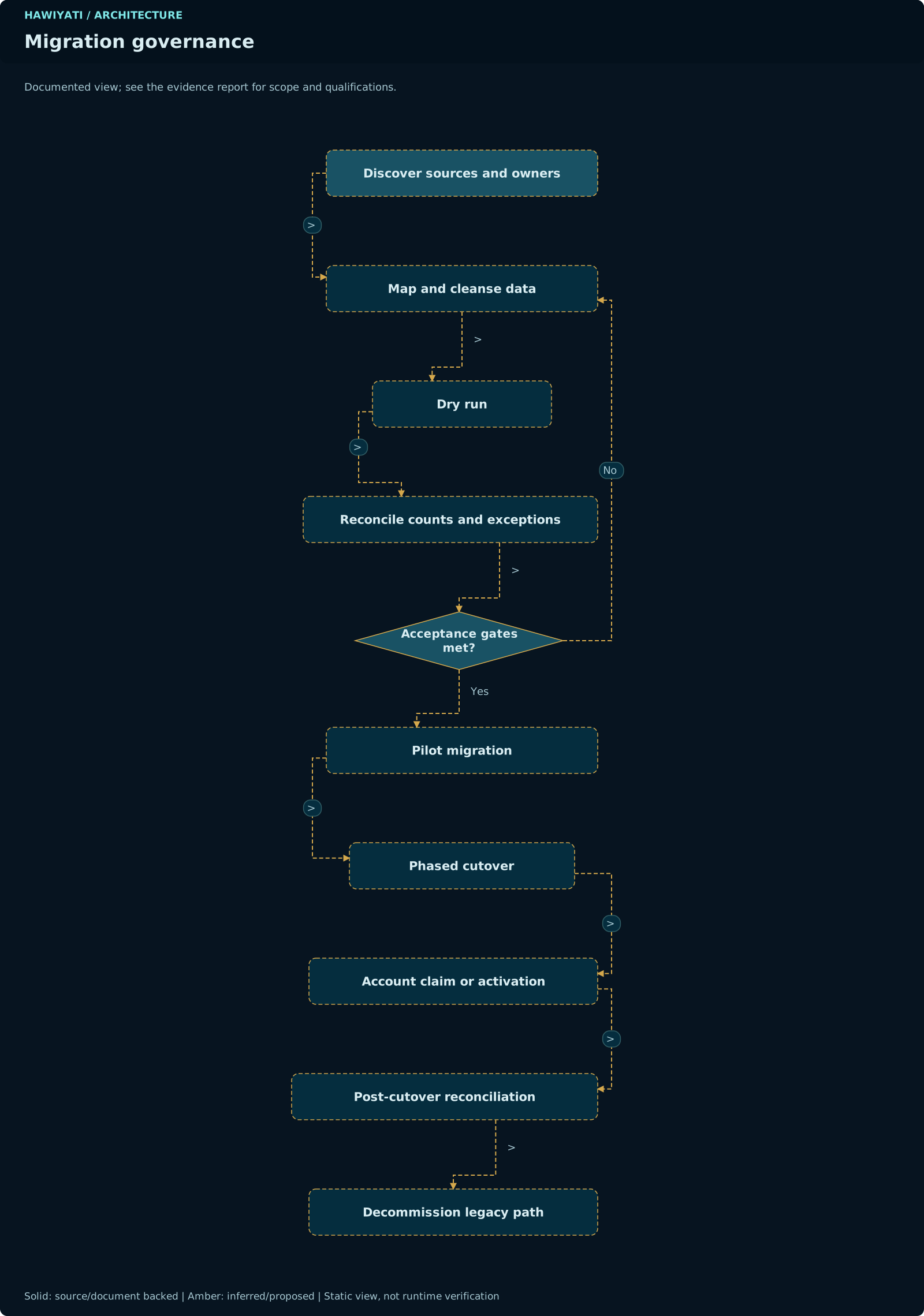
This guide was authored when the Flyway head was V53. The actual head as of 2026-10-17 is V62 (migrations V54–V62 were applied for other features: module config, KYC settings, CASCADE repairs). Renumber the migrations in this plan starting from V63 before implementing, and verify the live head with SELECT version FROM flyway_schema_history ORDER BY installed_rank DESC LIMIT 1.
P0 — Critical Fixes
These issues are security vulnerabilities or functional blockers that prevent the registration flow from working correctly.
- Delete
if (userService.existsByUsername(username))block atRegistrationController.java:311 - Verify
DataIntegrityViolationExceptioncatch at line 245 returnsunique_attribute_taken - Write HTTP-behavior test: response body must not contain
username_takenfor any username
KycRequiredException path causes a reactive chain deadlock and stores an unverifiable boolean on the WebSession. Replace with first-party completion token (V54).- Create V54 migration:
identity_completion_sessiontable - Create
CompletionSessionServicewithissue(),validate(),isAllowedRoute() - Replace exception throw in
LoginController.enforceAssuranceGate()with token issuance and redirect - Add WebFilter denying SAML/OIDC issuance endpoints when only a completion token is present
KycDecisionService.approve() must update kyc_profiles.current_level only — never users. Caps at L2 until biometric approved.- Check if
KycAssuranceLevelalready exists; addsatisfies(),fromString(),capAtFreezeLevel()to it or createIdentityAssuranceLevel - Update
KycDecisionService.approve()to writekyc_profiles.current_levelonly - Add
KycGateService.effectiveLevelFor(username)reading fromkyc_profiles
- Create V55 migration:
onboarding_continuation— note: nosp_initiation_urlcolumn - Create
OnboardingContinuationServicewithcreate()andconsume() - Wire into RegistrationController (on SP-initiated registration) and LoginController (on continuation redemption)
ConsentRecord already has ip_address and user_agent. Add a regression test so these fields cannot be silently removed.- Test:
register()verifiesconsentRepo.save()is called with non-null IP and user-agent
P1 — High Priority
country|docType|docNumber. Store in hawiyati_identity schema (not hawiyati_kyc). Duplicate match = manual review signal, not hard block.- Create V56 migration in
hawiyati_identityschema - Implement
KycEvidenceService.documentFingerprint()with normalization - Add duplicate-detection logic: different user →
MANUAL_REVIEW_REQUIRED, same user → allow - HMAC key from config property — never hardcoded
- Create V57 migration:
account_claim_token - Implement
AccountClaimTokenServicewithgenerate()andredeem() - Wire into invitation flow and account activation endpoint
P2 — Medium Priority
- Create V59 migration:
notification_outbox - Implement
NotificationOutboxService.enqueue()andenqueueIfAbsent() - Implement
OutboxDispatchJobwith SKIP LOCKED query and exponential backoff
- Create V58 migration:
ALTER users ADD external_id, source_instance_id - Update
ScimUser.HawiyatiExtensionrecord — verify noimportedPasswordHashorassuranceLevelfield exists - Update
ScimUserService.createUser()to map only the three permitted fields
- Create
ApiKycLifecycleControllerunderhawiyati-admin/…/admin/api/ - Implement
/api/v1/users/{id}/kyc/invalidate(SUPER_ADMIN) with upward-override guard - Implement
/api/v1/users/{id}/kyc/request-reverification(ADMIN)
P3 — Low Priority
- Add
commons-csv 1.10.0to hawiyati-admin pom.xml - Create V60 migration:
import_batch+import_batch_row - Implement
ImportBatchService— max 50,000 rows, 50 MB; quoted-field-safe CSV parsing - Create
ApiImportControllerat/api/v1/import/batches— upload, status, approve, commit - All committed rows:
active=false, pendingApproval=true
- Add
@Disabledtest documenting the requirement inKycConsentTest.java
Security Controls
Authentication boundary
| Control | Enforcement point | Notes |
|---|---|---|
| Username enumeration prevention | RegistrationController | Only constraint exception permitted; no pre-check |
| SAML/OIDC issuance gate | Issuance WebFilter | Denied if only a completion token is present in session |
| Completion token expiry | CompletionSessionService.validate() | 15-minute TTL enforced at DB level via expires_at |
| Continuation token user binding | atomicConsume(hash, userId) | Returns 0 rows on userId mismatch |
| Claim token purpose binding | atomicRedeem(hash, userId, purpose) | Password-reset token ≠ claim token |
| No upward assurance override | ApiKycLifecycleController | Returns 400 if target > current |
| SP allowlist for continuation | OnboardingContinuationService | Only registered SPs; URL resolved from registry |
| SCIM credential isolation | ScimUserService field mapping | No credential/assurance field accepted from SCIM |
Required integration tests
| Test | Category |
|---|---|
| Registration response identical for taken vs. available username | Enumeration |
| Completion token holder cannot POST to SAML assertion endpoint | Authorization boundary |
| Continuation token from user A cannot be consumed by user B | IDOR |
| Claim token with wrong purpose returns empty | Authorization |
| Admin invalidate with target > current returns 400 | No upward override |
| CSV with 50,001 rows rejected with clear error | Limit enforcement |
| Quoted CSV field containing comma parses correctly | Parsing correctness |
| Concurrent continuation redemption — exactly one wins | Concurrency (Testcontainers) |
| SKIP LOCKED — two dispatchers claim disjoint outbox rows | Concurrency (Testcontainers) |
| Document fingerprint duplicate routes to manual review, not hard block | Duplicate detection |
Every blocking database operation in a WebFlux pipeline must be wrapped with .subscribeOn(Schedulers.boundedElastic()). This applies to CompletionSessionService, OnboardingContinuationService, and KycGateService when called from reactive login flows.